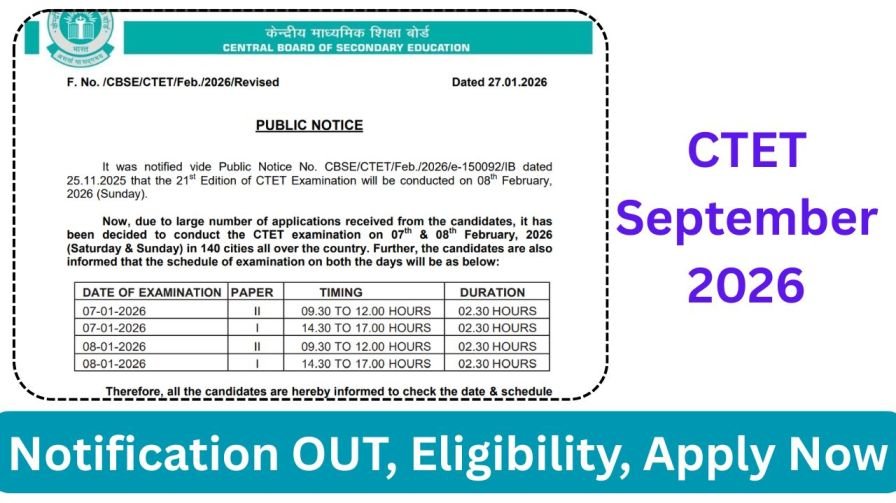
Every year, lakhs of teaching aspirants look forward to the Central Teacher Eligibility Test (CTET), and the September 2026 session is finally here. The Central Board of Secondary Education (CBSE) has officially released the CTET September 2026 notification on 11 May 2026. The online application window is already open and will remain active until 10 June 2026. The examination is scheduled to be held on 6 September 2026 (Sunday) across numerous test centres nationwide.
This detailed, SEO-optimised guide covers everything you need to know about CTET September 2026: important dates, eligibility conditions, application fee, detailed exam pattern, section-wise syllabus, step-by-step application process, admit card details, result declaration, certificate validity, and a reliable 4‑month preparation plan. Whether you are targeting Paper I for Classes 1–5 or Paper II for Classes 6–8, this article will serve as your one‑stop resource. Read on and bookmark this page to stay updated with every development.
⚠️ Important Note: Many candidates search for “CTET July 2026”, but CBSE has announced the second session as CTET September 2026 instead of the usual July slot. All information below pertains exclusively to the officially confirmed September 2026 session.
CTET September 2026 – Key Highlights at a Glance
| Particulars | Details |
|---|---|
| Conducting Body | Central Board of Secondary Education (CBSE) |
| Exam Name | Central Teacher Eligibility Test (CTET) |
| Session | September 2026 |
| Notification Release Date | 11 May 2026 |
| Application Start Date | 11 May 2026 |
| Last Date to Apply Online | 10 June 2026 (11:59 PM) |
| Correction Window | 15 – 18 June 2026 |
| CTET September 2026 Exam Date | 6 September 2026 (Sunday) |
| Admit Card Release | August 2026 (tentative) |
| Result Declaration | October – November 2026 |
| Exam Mode | Offline (OMR Sheet based) |
| Papers | Paper I (Classes 1–5), Paper II (Classes 6–8) |
| Official Website | ctet.nic.in |
CTET September 2026 Important Dates
Missing a crucial deadline can ruin a year’s preparation. Mark the following dates carefully in your calendar.
| Event | Date |
|---|---|
| Official Notification Published | 11 May 2026 |
| Online Application Form Starts | 11 May 2026 (Ongoing) |
| Online Application Closes | 10 June 2026 (11:59 PM) |
| Application Correction Period | 15 June to 18 June 2026 |
| Admit Card Download | Around August 2026 |
| CTET Exam 2026 (Paper I & II) | 6 September 2026 |
| Result Announcement | Expected October – November 2026 |
If the number of registered candidates is exceptionally high, CBSE may conduct the exam on 5 September 2026 as well. Keep checking the official portal for updates.
What is CTET?
The Central Teacher Eligibility Test (CTET) is a national‑level certification exam conducted by CBSE. Clearing CTET is mandatory for anyone who wishes to teach in central government‑run schools such as:
- Kendriya Vidyalaya Sangathan (KVS)
- Navodaya Vidyalaya Samiti (NVS)
- Army Public Schools
- Central Tibetan Schools
- Aided and unaided schools in Union Territories
The CTET certificate is now valid for a lifetime, thanks to a 2021 amendment. Earlier, its validity was only seven years. The exam comprises two papers:
- Paper I: For teaching Classes 1 to 5 (Primary Stage)
- Paper II: For teaching Classes 6 to 8 (Upper Primary Stage)
Candidates can apply for either one or both papers simultaneously if they wish to be eligible for all levels.
CTET September 2026 Eligibility Criteria
Before filling out the application, verify that you meet the qualification requirements laid down by CBSE.
For Paper I (Primary Level: Classes 1–5)
You need any one of the following:
- Senior Secondary (12th) with minimum 50% marks and a 2‑year Diploma in Elementary Education (D.El.Ed) OR
- 12th with at least 45% marks and a 2‑year Diploma in Special Education (as per RCI norms) OR
- 12th with 50% marks and a 4‑year Bachelor of Elementary Education (B.El.Ed) OR
- Graduation in any stream along with a 2‑year D.El.Ed OR
- 12th with 50% marks and a 2‑year D.Ed in Special Education
For Paper II (Upper Primary Level: Classes 6–8)
You need any one of the following:
- Graduation with at least 50% marks and a B.Ed degree from a recognised university OR
- Graduation with 45% marks and a B.Ed as per NCTE regulations OR
- 12th with 50% marks and a 4‑year integrated B.A.Ed / B.Sc.Ed or B.A.Ed / B.Sc.Ed (Special Education) OR
- Graduation with 50% marks and a 1‑year B.Ed (Special Education) OR
- 4‑year Integrated B.El.Ed / B.A.B.Ed / B.Sc.B.Ed degree holders are also eligible
Age Limit: Minimum age is 17 years. There is no upper age limit for CTET.
CTET September 2026 Exam Pattern
Understanding the structure of the test is half the battle won. The exam is held offline using OMR sheets. There is no negative marking, so attempting every question is highly recommended.
Paper I (Classes 1–5)
| Subject | No. of Questions | Marks |
|---|---|---|
| Child Development and Pedagogy (CDP) | 30 | 30 |
| Language I (compulsory) | 30 | 30 |
| Language II (compulsory) | 30 | 30 |
| Mathematics | 30 | 30 |
| Environmental Studies (EVS) | 30 | 30 |
| Total | 150 | 150 |
Paper II (Classes 6–8)
| Subject | No. of Questions | Marks |
|---|---|---|
| Child Development and Pedagogy (CDP) | 30 | 30 |
| Language I (compulsory) | 30 | 30 |
| Language II (compulsory) | 30 | 30 |
| Mathematics & Science OR Social Studies & Social Sciences | 60 | 60 |
| Total | 150 | 150 |
Key Exam Details:
- Duration for each paper: 2 hours 30 minutes (150 minutes)
- Medium of exam: 20 languages including English, Hindi, and 18 regional languages
- Negative Marking: None
- Qualifying Marks: 90 out of 150 (60%) for General category; 82 out of 150 (55%) for SC/ST/OBC/PwD
CTET September 2026 Syllabus – Section‑Wise Breakdown
A clear grasp of the syllabus is essential for targeted preparation. Below are the key topics for each section.
1. Child Development and Pedagogy (30 Questions – Both Papers)
- Child Development (15 questions): Theories of Piaget, Vygotsky, and Kohlberg; principles of development; language and thought; concept of intelligence; growth and development (focus on 0‑6 years).
- Inclusive Education (5 questions): Understanding diverse learners, addressing learning disabilities (dyslexia, ADHD), gifted children.
- Learning and Pedagogy (10 questions): How children learn, motivation, formative assessment, child‑centred education, critical thinking.
2. Language I and Language II (30 Questions each)
- Reading Comprehension (15 questions): Unseen passages (prose, poetry, or drama); questions on grammar, vocabulary, and inference.
- Pedagogy of Language Development (15 questions): Language acquisition vs learning, role of grammar, challenges in multilingual classrooms, teaching methods, evaluation of language skills.
Note: Language I is the medium of instruction chosen by the candidate; Language II is a second language. Both sections follow the same pattern but with different content.
3. Mathematics (Paper I) – 30 Questions
- Content (20 questions): Number system, fractions and decimals, operations (addition, subtraction, multiplication, division), geometry (shapes, 3D figures), measurements (weight, length, time, money), patterns, HCF and LCM.
- Pedagogical Issues (10 questions): Nature of mathematics at primary level, teaching‑learning materials (TLM), formal and informal evaluation, error analysis.
4. Environmental Studies – EVS (Paper I) – 30 Questions
- Content (15 questions): Family and friends, food and shelter, water, travel, plants and animals, environment and natural phenomena.
- Pedagogy (15 questions): Concept and scope of EVS, experiential learning, environmental education, project‑based learning, continuous and comprehensive evaluation (CCE).
5. Mathematics & Science (Paper II) – 60 Questions
- For candidates opting for the Science stream, the 60 questions are split equally (30 each) between Mathematics and Science.
- Mathematics: Number system, algebra, geometry, mensuration, data handling, and pedagogical understanding.
- Science: Food and materials, living world, natural phenomena, how things work, and pedagogy of science.
6. Social Studies & Social Sciences (Paper II) – 60 Questions
- This section covers History, Geography, Social and Political Life, and Economics, mostly from NCERT textbooks of Classes 6‑8. An additional segment tests the pedagogical methods for social science teaching.
CTET September 2026 Application Form – How to Apply Online
The registration and application process is entirely online. Follow these simple steps before the 10 June 2026 deadline.
Step 1: Visit the official website
Go to ctet.nic.in and click on the “Apply Online” link for CTET September 2026.
Step 2: New Registration
Enter basic details such as name, date of birth, mobile number, email ID, and create a password. Note down your registration number for future reference.
Step 3: Fill the Detailed Application
Log in with your credentials and fill in personal information, educational qualifications, choice of papers (Paper I / Paper II / Both), preferred language for the exam, and city preference.
Step 4: Upload Scanned Documents
Upload a recent passport‑size photograph and signature in JPEG format as per the prescribed dimensions (photo: 10–100 KB, signature: 3‑30 KB).
Step 5: Fee Payment
Pay the application fee using Credit Card, Debit Card, Net Banking, or UPI.
| Category | Paper I or II (only one) | Both Paper I & II |
|---|---|---|
| General / OBC | ₹1000 | ₹1200 |
| SC / ST / Differently Abled | ₹500 | ₹600 |
Step 6: Final Submission and Printout
After successful payment, submit the form. Download and print the confirmation page for your records. No hard copy needs to be sent to CBSE.
Application Correction Window (15–18 June 2026): If you made any mistake, you can edit some fields during this period by logging into your account.
CTET September 2026 Admit Card, Result, and Certificate
- Admit Card: Expected to be released in August 2026 on ctet.nic.in. Download it using your registration number and date of birth. Carry a printed copy along with a valid photo ID to the exam centre.
- Result: The result is usually declared within 4‑6 weeks after the exam. You can check it online by entering your roll number. Qualifying candidates will receive a digital mark sheet.
- CTET Certificate: Those who score 60% (or 55% for reserved categories) will be awarded an eligibility certificate. The certificate is now valid for a lifetime and can be used to apply for teaching vacancies in central schools anytime.
Frequently Asked Questions
Q1. Is CTET September 2026 confirmed?
Yes. CBSE released the notification on 11 May 2026, and the exam is fixed for 6 September 2026.
Q2. When will the CTET September 2026 exam be held?
The examination will be conducted on 6 September 2026 (Sunday). Paper II is usually in the morning shift (9:30 AM – 12:00 Noon) and Paper I in the afternoon shift (2:00 PM – 4:30 PM).
Q3. What is the last date to apply for CTET September 2026?
The application portal closes on 10 June 2026 at 11:59 PM. The correction window opens from 15 to 18 June 2026.
Q4. How much is the application fee?
General/OBC candidates pay ₹1000 for one paper and ₹1200 for both papers. SC/ST/PwD candidates pay ₹500 and ₹600 respectively.
Q5. Is the CTET certificate valid for a lifetime?
Yes, after a CBSE amendment in 2021, the CTET eligibility certificate remains valid for a lifetime.